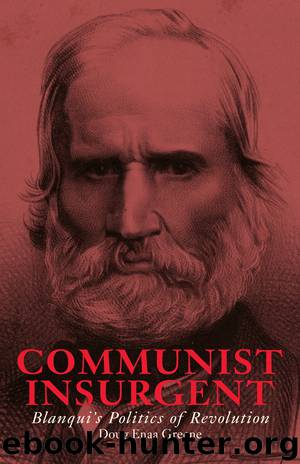
Communist Insurgent by Doug Enaa Greene
Author:Doug Enaa Greene
Language: eng
Format: epub
Publisher: Perseus Books, LLC
Published: 2017-10-03T04:00:00+00:00
STUDENTS AND INTELLECTUALS
By contrast, the Blanquists recruited some of their most dedicated and talented leaders from the students and the intellectuals. Those attracted to the Blanquist movement were generally convinced atheists. Religious questions among students in the Second Empire were bound to assume a political character, since as Patrick Hutton observed, “Louis-Napoléon’s deference to high ecclesiastical officials in the shaping of educational policy was bound to promote a new wave of anticlericalism.”17 Opposition to religion in general, and the Catholic Church in particular, meant that the Blanquists found a ready audience among students interested in radical atheist propaganda.
The Blanquists were the driving force behind the Free Thought Movement, a radical atheist movement that tied the question of religion to politics. The Free Thought Movement first achieved prominence in October and November of 1865 at the International Student Congress held in Liège. The Congress was originally conceived as an international forum to discuss religious questions. The French delegation was composed largely of Blanquists, making the conference hostile to religion. The Blanquists set the radical and anti-religious tone for the Congress by covering the tricolor in black and marching around the hall to mourn for the death of academic freedom in France. The government and the Church were embarrassed by the student radicalism and quickly clamped down. Not only were students who participated in the Congress expelled from the university (one of whom was Paul Lafargue), anyone who showed open sympathy for them received the same treatment.18
The heavy-handed repression generated a student backlash. The students staged strikes, boycotts, and street demonstrations. According to Hutton, “the Blanquists watched these activities closely, abetted the agitation, and even staged a public banquet and demonstration on January 21, 1866, on the Rue des Amandiers in eastern Paris in the hope of rousing workers’ support.”19 By the spring of 1866, the movement petered out when it became clear that the government would not accede to the students’ demands to reinstate their expelled comrades.
By the late 1860s, the more liberal press and assembly laws provided for more space for the dissemination of radical atheism. Many Blanquist students and intellectuals worked as journalists to propagate the atheist cause. From 1865 to 1870, they founded or participated in a number of militant atheist journals such as Candide, la Libre Pensée, la Nouvelle Pensée, and le Démocrite. Among the journalists was the brilliant medical student, Dr. Albert Regnard, a participant at the Liège Congress and later a theoretician of the Blanquist movement.
Download
This site does not store any files on its server. We only index and link to content provided by other sites. Please contact the content providers to delete copyright contents if any and email us, we'll remove relevant links or contents immediately.
| Anthropology | Archaeology |
| Philosophy | Politics & Government |
| Social Sciences | Sociology |
| Women's Studies |
The Secret History by Donna Tartt(19306)
The Social Justice Warrior Handbook by Lisa De Pasquale(12224)
Thirteen Reasons Why by Jay Asher(8998)
This Is How You Lose Her by Junot Diaz(6958)
Weapons of Math Destruction by Cathy O'Neil(6370)
Zero to One by Peter Thiel(5869)
Beartown by Fredrik Backman(5840)
The Myth of the Strong Leader by Archie Brown(5552)
The Fire Next Time by James Baldwin(5506)
How Democracies Die by Steven Levitsky & Daniel Ziblatt(5272)
Promise Me, Dad by Joe Biden(5190)
Stone's Rules by Roger Stone(5130)
A Higher Loyalty: Truth, Lies, and Leadership by James Comey(5017)
100 Deadly Skills by Clint Emerson(4973)
Rise and Kill First by Ronen Bergman(4839)
Secrecy World by Jake Bernstein(4799)
The David Icke Guide to the Global Conspiracy (and how to end it) by David Icke(4773)
The Doomsday Machine by Daniel Ellsberg(4556)
The Farm by Tom Rob Smith(4550)
